
The “plateau vs. mountain” models derived from E.B. Smith and P.W. Atkins describe two distinct trajectories for acquiring expertise and understanding complex subjects (specifically Physical Chemistry and Systems Thinking).
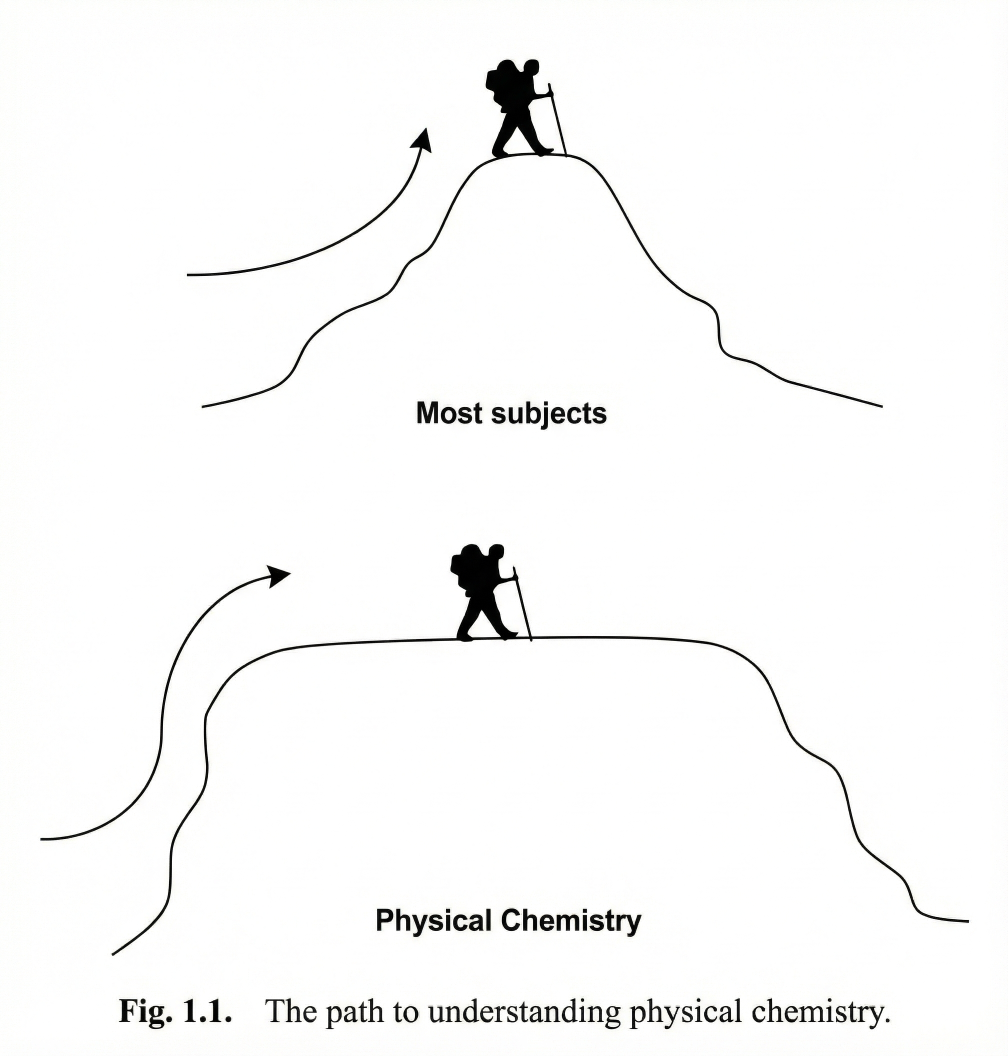
The distinction lies between the accumulation of facts (the Mountain) and the mastery of underlying principles (the Plateau).
1. The “Rugged Mountain” (Learning by Facts/History)
This model represents the traditional or historical approach to learning a discipline.
• The Path: It begins easily at the bottom but becomes progressively steeper and more difficult as one climbs,.
• The Method: It relies on the “patient accumulation of multicoloured facts” (described as “stamp collecting”) and following the historical narrative of discovery from confusion to resolution,.
• The Risk to Expertise: The learner ends up “tottering on a pile of shaky foundations.” If a new idea challenges the accumulated facts, the expert must “climb down and start again”. This approach leads to a fragmentation of knowledge where practitioners become experts in specific “techniques” or “niches” (like separate peaks) rather than understanding the coherent whole,.
2. The “High Plateau” (Learning by Principles)
This model, advocated by Smith and Atkins, represents the “formal” approach to expertise.
• The Path: The initial ascent is arduous. The learner must climb through “formidable cliffs” by following a “steep and tortuous path” early on,.
• The Method: This involves mastering abstract principles and postulates first, rather than accumulating empirical facts. It prioritizes “logic and elegance” over historical narrative.
• The Reward for Expertise: Once the “cliffs” of principle are scaled, the expert reaches a high plateau where the “upper reaches are open and relatively easy to traverse”.
• Economy of Thought: Because principles (like the laws of thermodynamics) apply universally, this approach is far more economical than memorizing “almanac-like facts”,. It allows the expert to “see for miles” and navigate new, complex problems with agility because they understand the underlying structure rather than just the specific instance.
Summary of Application to Systems Thinking
The author applies these models to argue that modern Systems Thinking has suffered from a “success catastrophe” by following the Mountain path—proliferating into isolated techniques and specialized jargon (the “bushfire”),.
True expertise in Systems Thinking, the author suggests, requires the Plateau approach: returning to the “Old Books” and foundational principles (such as those of Ashby, Weaver, and Vickers),. By mastering these core principles, an expert can navigate the “Goldilocks zone” of organized complexity without getting lost in the “noise” of modern academic specialization,.