Can you draw a mermaid diagram which illustrates the interplay of phase, stance and aspect
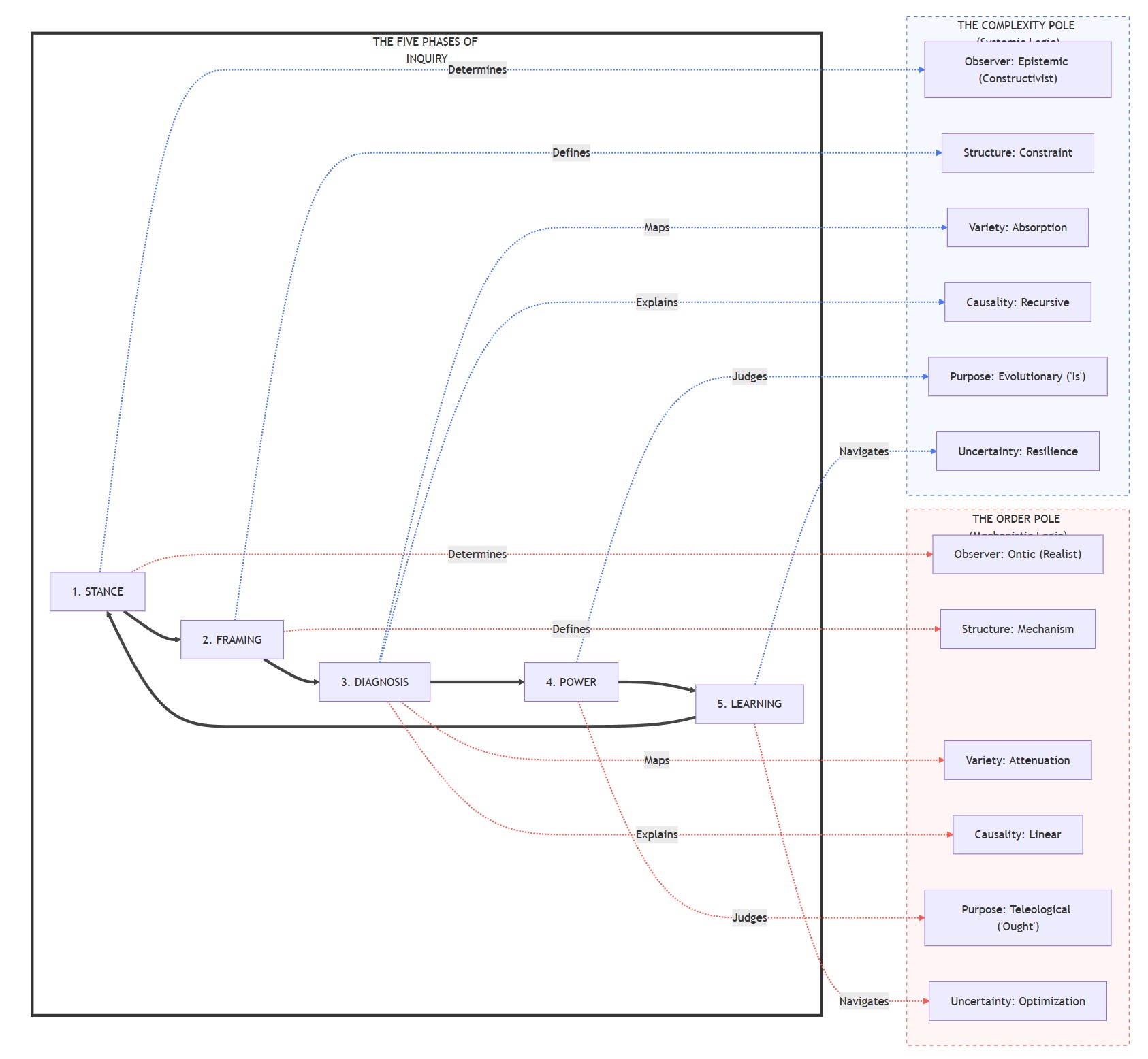
This Mermaid diagram illustrates the interplay of the five phases of inquiry, the two philosophical poles, and the six specific aspects (trade-offs) that a practitioner must navigate to “master the muddle” of complex systems.
The Interplay of Systemic Inquiry
Explaining the Interplay
The interplay is a recursive loop where each Phase of the investigation requires a conscious choice along the Aspect trade-offs, depending on whether the situation leans toward the Order or Complexity pole.
1. Phase 1: Stance (The Observer Aspect)
◦ The investigator must decide if they are discovering an objective, external reality (Ontic/Realist) or if they are “bringing forth” a world through their own distinctions (Epistemic/Constructivist)[1][2].
2. Phase 2: Framing (The Structure Aspect)
◦ Framing determines if the system is viewed as a collection of independent, decomposable parts (Mechanism) or as a web of relational Constraints where the whole regulates the parts[3].
3. Phase 3: Diagnosis (The Variety & Causality Aspects)
◦ Variety: The practitioner chooses to either filter out noise to simplify control (Attenuation) or boost internal complexity to handle environmental variety (Absorption)[6][7]. ◦ Causality: Diagnosis identifies if the system is driven by direct, forceful triggers (Linear) or circular feedback loops where cause and effect are distant in time (Recursive)[8][9].
4. Phase 4: Power (The Belief/Teleology Aspect)
◦ Handling power dynamics involves deciding if the system should be designed to achieve a specific future goal (Teleological/Ought) or if it should be allowed to follow its natural “structural drift” (Evolutionary/Is)[10].
5. Phase 5: Learning (The Uncertainty Aspect)
◦ The final phase determines if the goal is to reach a single “best practice” state (Optimization) or to “muddle through” to maintain the system’s ability to survive stressors (Resilience/Antifragility)[13].
Does this visual representation clarify how the “dials” of systems thinking are adjusted during the different stages of your investigation?
References
[1] 💬Perspectives.md [2] 💬Perspectives.md [3] 💬Nutshell (Process).md [6] 💬Nutshell (Process).md [7] 💬Nutshell (Process).md [8] 💬Questions.md [9] 💬What is Complexity.md [10] 💬Questions.md [13] 💬Nutshell (Process).md
Define the Poles as Background Subgraphs subgraph Order_Pole [“THE ORDER POLE (Mechanistic Mindset)”] direction TB A1[“Observer: Ontic (Realist)”] B1[“Structure: Mechanism”] C1[“Variety: Attenuation”] D1[“Causality: Linear”] E1[“Uncertainty: Optimization”] F1[“Belief: Teleological (‘Ought’)”] end
subgraph Phases ["THE FIVE PHASES OF INQUIRY"]
    direction TB
    P1["1. STANCE"]
    P2["2. FRAMING"]
    P3["3. DIAGNOSIS"]
    P4["4. POWER"]
    P5["5. LEARNING"]
end

subgraph Complexity_Pole ["THE COMPLEXITY POLE (Systemic Mindset)"]
    direction TB
    A2["Observer: Epistemic (Constructivist)"]
    B2["Structure: Constraint"]
    C2["Variety: Absorption"]
    D2["Causality: Recursive"]
    E2["Uncertainty: Resilience"]
    F2["Belief: Evolutionary ('Is')"]
end

 The Phase Cycle
P1 ==> P2 ==> P3 ==> P4 ==> P5 ==> P1