The source of the Tower of Thinking (also referred to as the Tower of Thought) concept in these materials is Roger James[1][2].
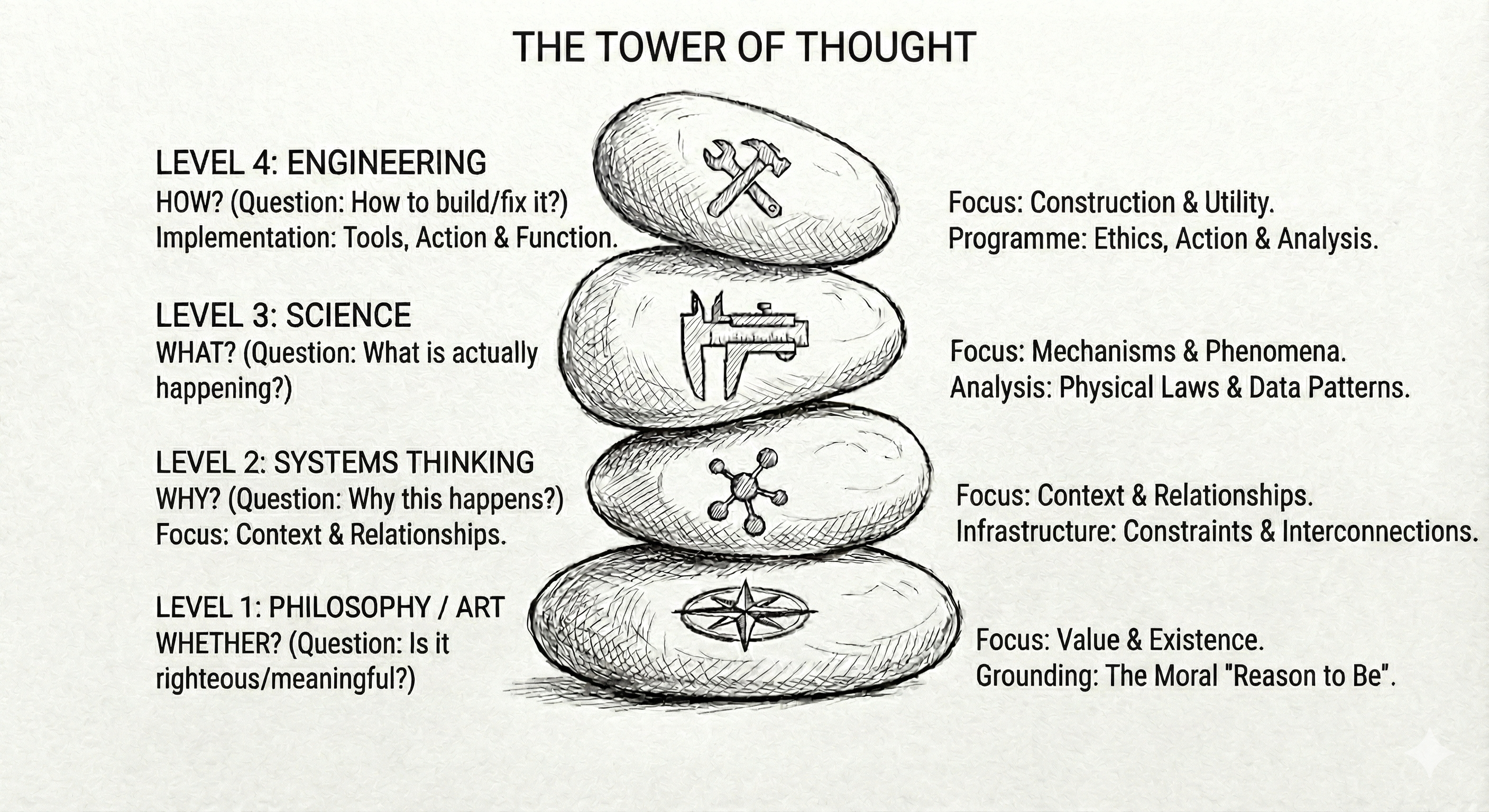
James uses this hierarchical framework to organize human inquiry from high-level philosophical abstraction down to practical engineering utility, helping analysts navigate the transition between raw observation and structured action[3].
The Four Levels of the Tower
The hierarchy is structured around four distinct levels, each defined by a specific primary question and area of focus[3]:
• Level 1: Philosophy / Art (Question: Whether?****): Focuses on Value and Existence. It asks if a pursuit is righteous, beautiful, or meaningful, and why one should do it at all[3].
• Level 2: Systems Thinking (Question: Why?****): Focuses on Context and Relationships. It asks why something happens rather than something else and identifies the governing constraints[3][4].
• Level 3: Science (Question: What?****): Focuses on Mechanisms and Phenomena. It seeks to identify what is actually happening and the underlying physical laws or patterns[3].
• Level 4: Engineering (Question: How?****): Focuses on Construction and Utility. It addresses the specific steps needed to build, fix, or make a system work[3].
Key Functions of the Concept
• Navigating the Epistemic Cut: The Tower is used to manage the critical gap between the material world (what is) and the symbolic world (what we think or say about it)[1][5].
• Managing Cognitive Load: It allows an observer to focus on a single level of recursion at a time, preventing “mental freefalling” or getting lost in overwhelming detail[6].
• Calibration of Perspective: Effective inquiry involves climbing up the tower to gain context (e.g., from Engineering to Systems Thinking) and then dropping back down to ground those abstractions in reality[6].
Would you like to see how these levels apply to a specific problem you are currently investigating, or perhaps explore the “Epistemic Cut” that sits at the base of this tower?
References
[1] 💬Gists.md [2] 💬Questions.md [3] 💬Questions.md [4] 💬Questions.md [5] 💬Nutshell (Process).md [6] 💬What is Complexity.md