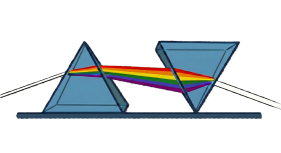
Based on the provided sources, a “double description” reveals hidden patterns in risk by generating a new, higher order of information that is not contained within any single perspective alone. Just as binocular vision combines two slightly different two-dimensional views to generate the third dimension of depth[1],[2], double description combines different sources of information to reveal the “pattern which connects,” thereby exposing systemic risks, relationships, and contexts that remain invisible to a single-point perspective[3],[4].
Here is how double description reveals these hidden patterns:
1. Generating “Depth” and Insight through Difference
Risk is often hidden when we look at a problem through a single “monocular” frame (e.g., financial data alone, or engineering specs alone). Bateson argues that “two descriptions are better than one” because the difference between two descriptions is itself information of a higher logical type[5],[4].
• The Bonus of Insight: When two different sources of information (e.g., an anatomical description and an evolutionary description, or the view of a regulator and the view of an operator) are combined, they generate a “bonus” of understanding[6],[7]. This bonus is the perception of relationship and context—the “depth” that allows an observer to see how a system is organized and where it might be vulnerable[8].
• Locating the System: Risk does not exist in a single component (like a “dangerous” machine) but in the relationship between components (the man, the machine, and the environment)[9]. Double description forces the observer to focus on the relationship rather than the individual parts, revealing that the unit of survival (and therefore the unit of risk) is not the organism, but the “organism plus environment”[10],[11].
2. Identifying “Moiré Patterns” of Interference
Bateson uses the analogy of Moiré patterns to explain how hidden risks emerge from the interaction of seemingly safe components.
• Emergent Patterns: When two repetitive patterns (like two wire screens) are superimposed, they generate a third, distinct pattern[12],[13]. In a risk context, two standard operating procedures that are safe individually might, when interacting, generate a third, unforeseen pattern of behavior (a “beat”) that causes systemic failure[14],[15].
• Prediction: If an observer has descriptions of two separate rhythmic patterns, they can predict the third “interference” pattern[14],[16]. Using double description allows risk managers to investigate an unfamiliar or hidden pattern by combining known patterns and inspecting the result[17].
3. Exposing Schismogenesis (Escalating Risk)
Hidden patterns of risk often take the form of schismogenesis—a self-reinforcing escalation (vicious circle) that leads to system breakdown[18],[19].
• Symmetrical vs. Complementary: A single view might see a behavior (e.g., boasting, armament production, or risk-taking) as a static trait. A double description reveals whether the relationship is symmetrical (A boasts, so B boasts more) or complementary (A dominates, so B submits)[18],[20].
• Predicting Runaway: By mapping these interactions, double description reveals if the system is in a state of “runaway”—where positive feedback loops are pushing variables toward lethal limits[21],[22]. For example, in the “arms race” of an alcoholic, the symmetrical pride of “I can handle it” escalates against the complementary reality of addiction, leading to collapse[23],[24].
4. Abduction: Revealing Formal Similarities
Double description allows for abduction, a form of reasoning that looks for similar rules or patterns in widely different contexts (e.g., comparing the anatomy of a crab to the structure of a society)[25],[3],[26].
• Lateral Extension: By comparing a known system (like a biological organism) with an obscure one (like a corporate culture), an observer can identify the “pattern which connects” them[27]. If the biological system collapses when its flexibility is consumed, abduction suggests the corporate system faces the same risk if it maximizes efficiency at the expense of adaptability[28],[29].
• Checking Validity: Since we cannot always trust a single description, we use abduction to see if a rule holds true across different logical types or systems[25],[30]. This creates a “double requirement” for change to be viable: it must fit internal coherence and external environmental requirements[31].
5. Detecting Errors in Logical Typing
Risk controls often fail because they confuse the “map” with the “territory” or the class with the member—an error of logical typing[32],[33].
• Cross-Contextual Analysis: A double description (e.g., comparing the “rules” of a game with the “playing” of the game) reveals when a system is trapped in a double bind—a situation where a primary injunction (Level 1) is contradicted by a secondary injunction (Level 2)[33],[34].
• Pathology of Communication: By looking at both the content of a message (digital) and the context/relationship (analog), double description exposes the paradoxes that freeze adaptive capability and lead to pathology or “madness” in families and organizations[35],[36].
Summary
In the context of risk, a double description acts as a corrective to the “epistemological error” of viewing the world as a collection of separate parts[37]. By combining multiple perspectives (structural vs. processual, internal vs. external, genetic vs. somatic), it reveals the circular causality and feedback loops that constitute the true dynamics of the system[38],[39]. This allows the observer to perceive the “time-grain” of the system and identify where short-term adaptations are destroying long-term flexibility[40],[41].
References
[1] (Biosemiotics 2) Associate Professor Jesper Hoffmeyer (auth.), Associate Professor Jesper Hoffmeyer (eds.) - A Legacy for Living Systems_ Gregory Bateson as Precursor to Biosemiotics-Springer Netherla.pdf [2] Bateson_MindNature.pdf [3] A Legacy for Living Systems - Gregory Bateson as Precursor to Biosemiotics.pdf [4] [Book] Bateson Gregory - Mind and Nature.pdf [5] Bateson_MindNature.pdf [6] (Biosemiotics 2) Associate Professor Jesper Hoffmeyer (auth.), Associate Professor Jesper Hoffmeyer (eds.) - A Legacy for Living Systems_ Gregory Bateson as Precursor to Biosemiotics-Springer Netherla.pdf [7] Bateson_MindNature.pdf [8] [Book] Bateson Gregory - Mind and Nature.pdf [9] Hawkins A centennial tribute to Gregory Bateson.pdf [10] [Book] Bateson - Steps to an Ecology of Mind_ Collected Essays in Anthropology, Psychiatry, Evolution, and Epistemology.pdf [11] [Book] Gregory Bateson - Steps to an Ecology of Mind.pdf [12] (Biosemiotics 2) Associate Professor Jesper Hoffmeyer (auth.), Associate Professor Jesper Hoffmeyer (eds.) - A Legacy for Living Systems_ Gregory Bateson as Precursor to Biosemiotics-Springer Netherla.pdf [13] A Legacy for Living Systems - Gregory Bateson as Precursor to Biosemiotics.pdf [14] (Biosemiotics 2) Associate Professor Jesper Hoffmeyer (auth.), Associate Professor Jesper Hoffmeyer (eds.) - A Legacy for Living Systems_ Gregory Bateson as Precursor to Biosemiotics-Springer Netherla.pdf [15] Bateson_MindNature.pdf [16] [Book] Bateson Gregory - Mind and Nature.pdf [17] [Book] Bateson Gregory - Mind and Nature.pdf [18] Bateson_Gregory_Steps_to_an_Ecology_of_Mind.pdf [19] [Book] Bateson - Steps to an Ecology of Mind_ Collected Essays in Anthropology, Psychiatry, Evolution, and Epistemology.pdf [20] Bateson_Gregory_Steps_to_an_Ecology_of_Mind.pdf [21] Bateson_Gregory_Steps_to_an_Ecology_of_Mind.pdf [22] The Pattern which connects Gregory Bateson.pdf [23] Bateson_Gregory_Steps_to_an_Ecology_of_Mind.pdf [24] [Book] Gregory Bateson - Steps to an Ecology of Mind.pdf [25] (Biosemiotics 2) Associate Professor Jesper Hoffmeyer (auth.), Associate Professor Jesper Hoffmeyer (eds.) - A Legacy for Living Systems_ Gregory Bateson as Precursor to Biosemiotics-Springer Netherla.pdf [26] [Book] Bateson Gregory - Mind and Nature.pdf [27] A Legacy for Living Systems - Gregory Bateson as Precursor to Biosemiotics.pdf [28] Bateson_Gregory_Steps_to_an_Ecology_of_Mind.pdf [29] [Book] Bateson Gregory - Mind and Nature.pdf [30] Bateson_MindNature.pdf [31] [Book] Bateson Gregory - Mind and Nature.pdf [32] Bateson - Form Substance and Difference.pdf [33] Bateson_Gregory_Steps_to_an_Ecology_of_Mind.pdf [34] [Book] Gregory Bateson - Steps to an Ecology of Mind.pdf [35] Bateson_Gregory_Steps_to_an_Ecology_of_Mind.pdf [36] [Book] Bateson - Steps to an Ecology of Mind_ Collected Essays in Anthropology, Psychiatry, Evolution, and Epistemology.pdf [37] Bateson - Small arcs of Large Circles.pdf [38] (Biosemiotics 2) Associate Professor Jesper Hoffmeyer (auth.), Associate Professor Jesper Hoffmeyer (eds.) - A Legacy for Living Systems_ Gregory Bateson as Precursor to Biosemiotics-Springer Netherla.pdf [39] Bateson 1991 - Cybernetic Explanation.pdf [40] Bateson_Gregory_Steps_to_an_Ecology_of_Mind.pdf [41] [Book] Bateson - Steps to an Ecology of Mind_ Collected Essays in Anthropology, Psychiatry, Evolution, and Epistemology.pdf