Much of the confusion surrounding the concept of information stems from a failure to distinguish between the physical mechanism (ontological reality) and the abstract conceptualization (epistemic view). To understand information, we must understand the linkage between these two perspectives.
Alan Kay utilizes the stone arch as a primary example of emergence: a phenomenon where the properties of individual parts are transcended through their specific relationship within an assembly. This model is universal:
- Parts: Stones (physical) or People (social).
- Fields: Gravity (physical) or Culture (social).
- Potential: Gravitational Energy (physical) or Customer Satisfaction (social).
Three States of Arrangement: From Chaos to Architecture
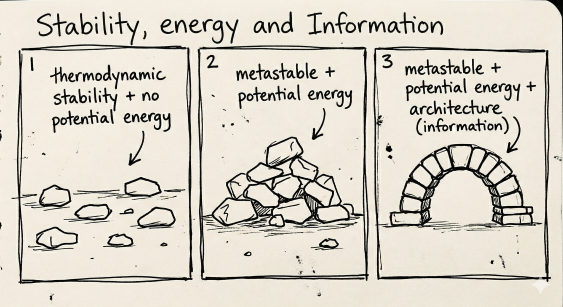
The relationship between stability, energy, and information can be visualized through three distinct configurations of stones:
| Structure | State | Description | Information Content |
|---|---|---|---|
| 1. Isolated Stones | Thermodynamically Stable | Stones are separate and random. There are no relationships between them. This represents the “heat death” of a system—a state of maximum entropy. | Zero: No structure or design exists. |
| 2. Random Pile | Disorganized Metastable | Stones are heaped together. It possesses potential energy (some stones could fall) but is held in place by friction. It is a “probable” structure requiring no skill to build. | Low: No intelligent design; represents basic accumulation (e.g., a simple pyramid). |
| 3. Stone Arch | Organized Metastable | Stones are arranged in a specific, functional layout. It has potential energy and may requires a history of construction (scaffolding) that is not visible in the final state. | High: Requires specific design/knowledge to select this “one” state from many. |
| Architecture (etymologically rooted in the stone arch) is the discipline of understanding how specific configurations extend the properties of their component parts. Within this framework, Cybernetics serves to identify the “one” feasible design by eliminating the “unfeasible many.” As W. Ross Ashby suggested, the cyberneticist observes what could have happened, but did not, thereby defining the system through its constraints. |
Information is Not Energy
While information and energy are deeply linked, they are not interchangeable. Energy resides within the physical system; useful work is generated by the relaxation between different physical configurations, not by the information itself.
Information may describe or guide the process, but it cannot override the physical substrate. In systems thinking, abstract modeling may identify theoretical states, but those states cannot exist unless the physical reality allows for them (the constraint of ergodicity).
The Systems Thinker’s Maxim: “Behind every valid or useful epistemic view there lies an ontological reality. Otherwise it is not Systems Thinking but Philosophy.”
The imagination of Einstein matched with the genius of Eddington
This model dismantles “fanciful” management theories regarding energy gradients and entropy. It concludes that you cannot manage a system through abstract “information” alone without addressing the underlying physical or social “stones.”
Strategic Advice for “Nudging” (Transitioning States)
To move a system toward a desired state (the transition from disorganized to organized), consider these thermodynamic principles:
Input vs. Relaxation: Moving from a simple state to a complex one (Left to Right) requires an injection of resources. Moving from potential to work (Right to Left) involves relaxation—releasing held resources.
- Identify Potential: Ensure the target system already possesses the inherent potential to exhibit the desired behaviour.
- Address the Kinetic Barrier: If a system is metastable (stuck), identify the “friction” or restraining factors preventing relaxation. The goal is to “relax” the system so it can perform work.
- Create Asymmetry: During the relaxation process, introduce an asymmetry to focus the energy release, thereby increasing the yield of the desired outcome.