
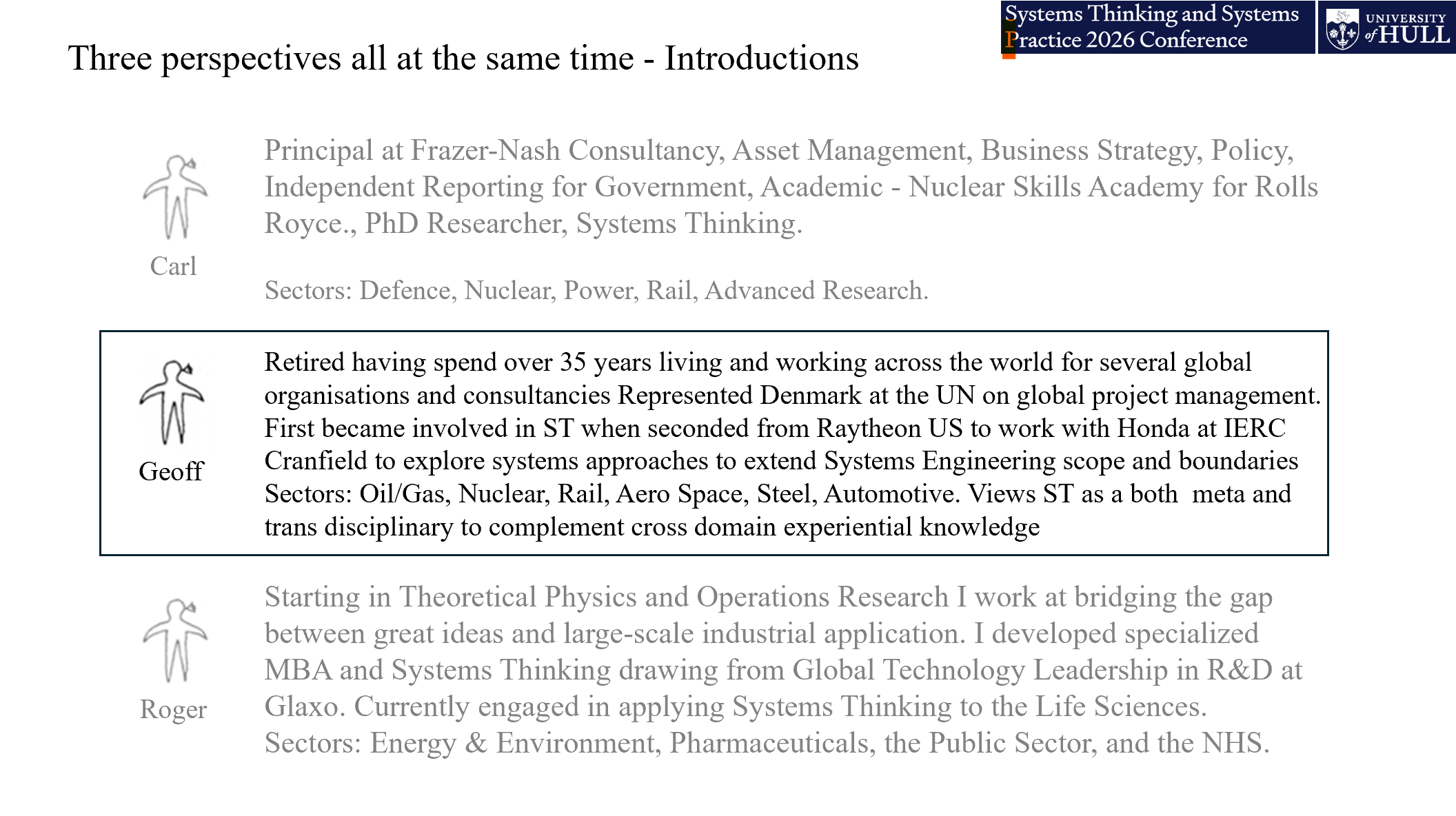
 Some of you will know Geoff from his LinkedIn posts and his mentoring of many individuals in Systems Thinking. Geoff has rather strong views based on his own deep experience. He first ‘stumbled’ across thinking in systems at sixth form level through an inspiring physics teacher and colleague of Fred Hoyle. His introduction to Systems Thinking was whilst commissioning an oil refinery in Algeria when in his 20’s - a formative real world experience. His academic exposure arose almost by accident - he was seconded to IERC at Cranfield (Honda) working with ST alumni such as Bill Mayon-White, then at LSE with Larry Philips and the Decision Making group. He is a qualified scientist and metallurgist and as likely to explain the actual phase transition of metal alloys as its bogus use as metaphor in management writing where the author demonstrates no understanding of what a phase transition is, or the factors that define and determine phase.
He is a practitioner first and academic second and has been thrown in to the deep end to use SODA in a bank, MOOD in Vodaphone, deep smarts in LUL.
Geoff and I both worked at ICI Petrochemicals in the late 70’s - me on commissioning Olefin 6, Geoff on learning process engineering through Anne Shaw (Lilian Gilbreth) - (practitioner) Queen of Systems Thinking. This was Checkland’s background and his back catalogue of SSM in ICI is notably thin
Some of you will know Geoff from his LinkedIn posts and his mentoring of many individuals in Systems Thinking. Geoff has rather strong views based on his own deep experience. He first ‘stumbled’ across thinking in systems at sixth form level through an inspiring physics teacher and colleague of Fred Hoyle. His introduction to Systems Thinking was whilst commissioning an oil refinery in Algeria when in his 20’s - a formative real world experience. His academic exposure arose almost by accident - he was seconded to IERC at Cranfield (Honda) working with ST alumni such as Bill Mayon-White, then at LSE with Larry Philips and the Decision Making group. He is a qualified scientist and metallurgist and as likely to explain the actual phase transition of metal alloys as its bogus use as metaphor in management writing where the author demonstrates no understanding of what a phase transition is, or the factors that define and determine phase.
He is a practitioner first and academic second and has been thrown in to the deep end to use SODA in a bank, MOOD in Vodaphone, deep smarts in LUL.
Geoff and I both worked at ICI Petrochemicals in the late 70’s - me on commissioning Olefin 6, Geoff on learning process engineering through Anne Shaw (Lilian Gilbreth) - (practitioner) Queen of Systems Thinking. This was Checkland’s background and his back catalogue of SSM in ICI is notably thin
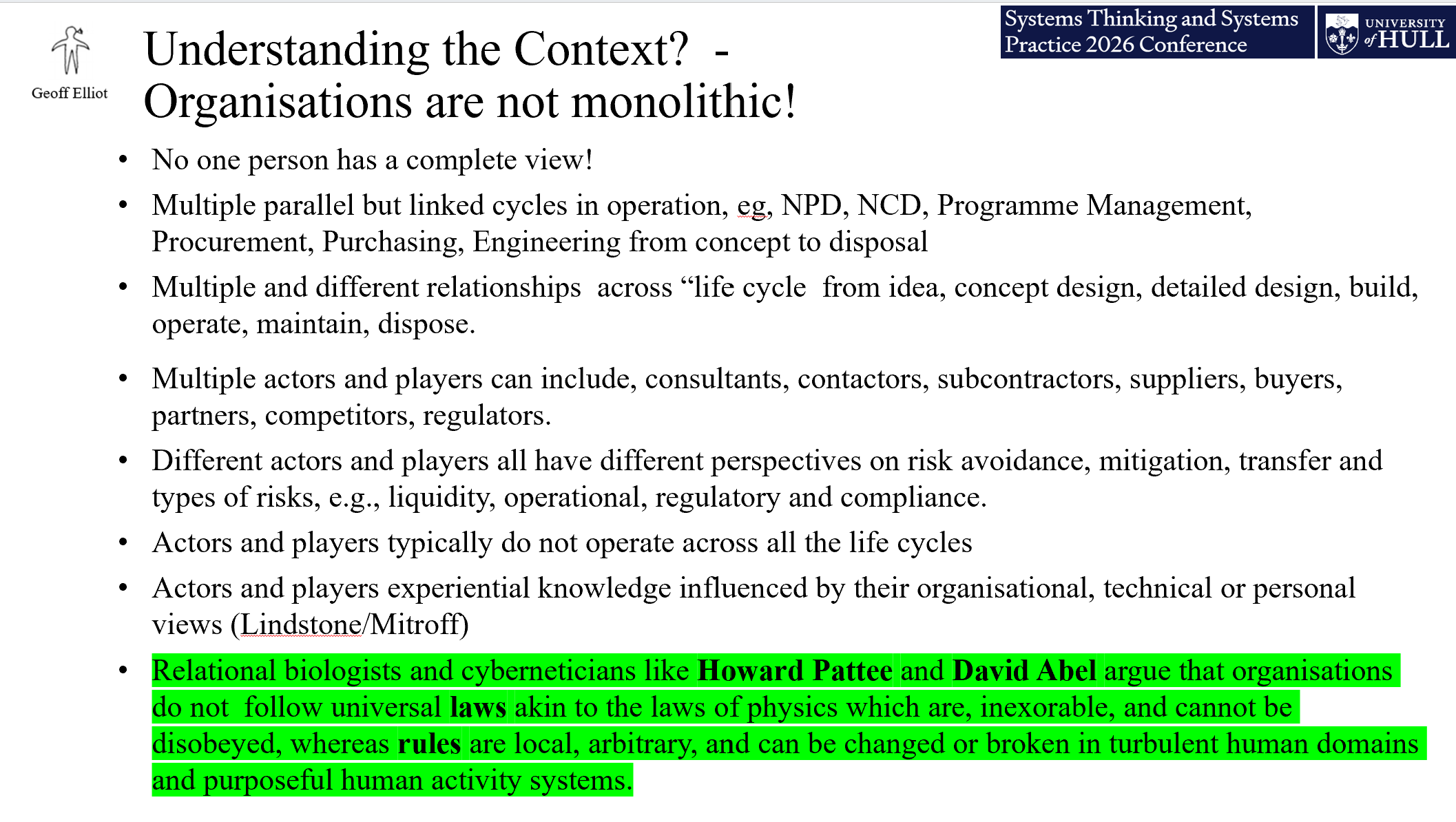 Following hard on Geoff’s view of second order Systems Thinking (systems don’t exist) Geoff focuses on the significance of the observer and the effect of perspective. He has many examples here - for example over 30% of calls to a help line were for social contact or his work with a post-Seddon initiative on failure demand in housing tenants where the council tenants took the bulbs and sold them on.
One of his favourite case studies is the development of the M15 carbine - this became a liability on the Vietnam battlefield because of a technical issue but the circumstances were driven by discordant and ultimately destructive perspectives. The tl;dr version of which was: 1. in World War 2 less than 30% of soldiers fired their weapons in action they needed a ‘tommy gun’ 2. in the replacement programme ‘central staff’ were looking for a sniper rifle and demanded a heavier calibre round 3. the ‘late change’ of calibre produced debris that jammed the weapon on active firing 4. the front line troops quicky lost faith in the weapon
Following hard on Geoff’s view of second order Systems Thinking (systems don’t exist) Geoff focuses on the significance of the observer and the effect of perspective. He has many examples here - for example over 30% of calls to a help line were for social contact or his work with a post-Seddon initiative on failure demand in housing tenants where the council tenants took the bulbs and sold them on.
One of his favourite case studies is the development of the M15 carbine - this became a liability on the Vietnam battlefield because of a technical issue but the circumstances were driven by discordant and ultimately destructive perspectives. The tl;dr version of which was: 1. in World War 2 less than 30% of soldiers fired their weapons in action they needed a ‘tommy gun’ 2. in the replacement programme ‘central staff’ were looking for a sniper rifle and demanded a heavier calibre round 3. the ‘late change’ of calibre produced debris that jammed the weapon on active firing 4. the front line troops quicky lost faith in the weapon
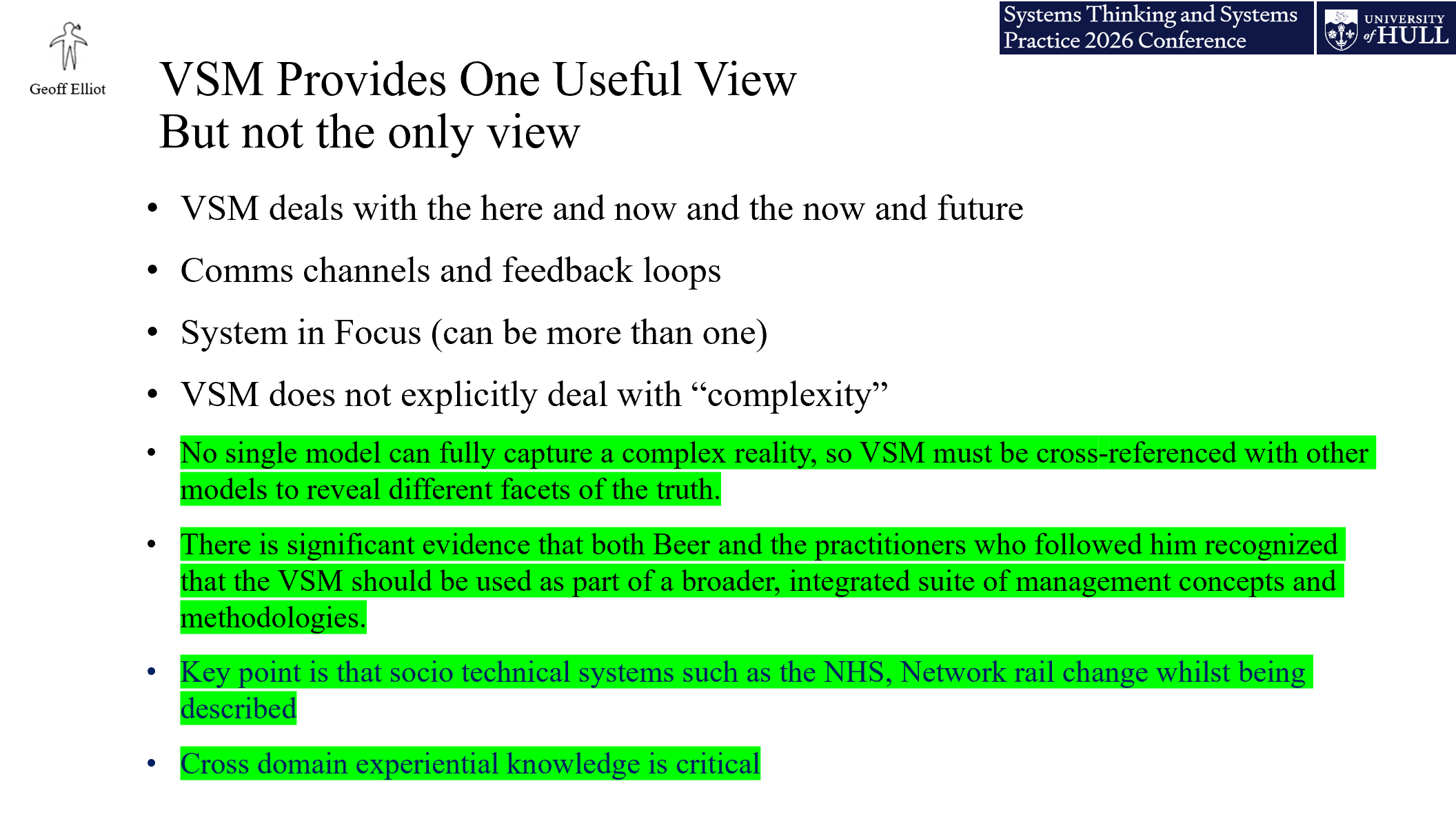
Unsurprisingly Geoff has a view on VSM - which he regards as a useful tool but not as the definitive or only tool. He criticises the use of VSM in strategy simply because ‘of the arrows’. Whilst S1 can influence and relies upon S5 the reverse proposition that S5 can determine S1 fails because of the effect of embedded assets. Described as S1 cuts (material control) and S5 chooses (epistemic control), but the reverse case of S5 having material control - S5 cuts and S1 chooses - does not work. As an example, of a steel works, the type of blast furnace and logistics constrains and invalidates any ‘wishful thinking’ of the S5 - this was ably demonstrated by the case of Mr Pastry (Sir Charles Villiers = S5) a notable loss making chair of British Steel and Black Bob who followed (Sir Robert Scholey = S1) a descendant of United Steel (Beer’s stomping ground).
If the PMO (Project Management Office) lacks the technical literacy to understand Systems Engineering or Industrial Cybernetics, they cannot act as a functional System 2 (Coordination) or System 3 (Control). Instead of being the “regulator” that ensures IDEF0-style controls are met, the PMO becomes a reporting bureau, merely documenting the chaos rather than preventing it. - report on Network Rail.
“CEOs don’t have patterns of strategy they have operational and strategic constraints”
This is the challenge to strategy where as more and more operations become subjected to ‘embedded assets’ through regulation or automation and the ‘air head’ S5 strategists become less relevant. We can ask Geoff if he will share is Mr Pasty/Black Bob case study.
“Recently formalised Systems Thinking for civil servants, their official guidance almost entirely ignores functional engineering models in favour of social ones” - requiring process models such as IDEF0. You don’t need a track & signalling protocol for a fleet of Segways, you do for a fleet of freight trains.
In summary Geoff can explain a realist view of the world, replete with case studies and vignettes of the oddly improbable. His summary is that ‘deep smarts’ matter and that successful Systems Thinking requires specific and detailed domain knowledge (experiential knowledge).