
The founding principle of the design of STPrism is to augment the abilities of the Systems Thinking not to replace (automate) them. The principle of augmentation not automation is long established by the MIT academic Michael Schrage (and recently ‘dusted off’ by the new AI generation - see the advertorial at The AI-powered workforce).
£ End-Point Subscriptions
In STPrism the end point is the QSet NotebookLM (a text file of approximately 200,000 words) which encapsulates and digest the works of leading authors and thinkers on specific topics. As is evident from the try It this is massively portable and sharable with access rights that can be managed on a subscription basis. There is no requirement for client based infrastructure nor the need to transfer any (proprietary) data files to the client’s systems.
This is valuable compression and digest of the chosen topic but shared as ‘chat only’ it is also a useful encryption of the source information, it prevents fishing inquiries on the QSet and access to the source data is completely blocked. The responses to the prompts are therefore a bit like a lottery - you might be lucky - but you cannot follow up to check sources, to examine the pedigree of the idea or to dive deeper into the source information.
£ The 5-minute Refresher
One of the challenges of Systems Thinker (and other approaches) is that for many Systems Thinking is reserved for high days and holidays, it is not a everyday activity! My explanation of this is the effort of the ‘cognitive load of all that Systems Thinking stuff’, it is not that their experience or training in Systems Thinking is lost simple buried by all the other stuff.
The ideas behind STPrism is to break this ‘headful limit’ and it is a useful, easy and quick reminder of ideas you already know (the high yield Rememex principle). It could be presented as a service for users to keep the Systems Thinking plates spinning in their mind. (The try it) experience illustrates how quickly you can employ it on existing challenges.
£ Sponsored Subscriptions
Professional societies or ‘thought leading’ organisations and companies may choose to sponsor and make available the definitive QSet for their professed area of expertise on the basis that the access to their proprietary information is an asset in its own right. In a replacement of the value of advertising (measured by visitors) this would be much more targeted and specific - who else would be interested in a book on Systems Thinker than a habitual user of a Systems Thinking QSet.
£ The Foundations of a Proprietary Element
Used on its own, as a NotebookLM, the ‘system’ will produce findings an insight which may find difficulty in interpretation (what does Questioning Insight means), sourcing (where does it come from) and implementation (how can I use the idea). There are also other aspects of the curation of the authors (who is included) and managing pollution (which sources obscure the key ideas) and whether particular sources are available (which are out-of-print books, private sources and unpublished papers).
A gateway service - follow-ups, explanations, audit trails, evidence base, reportage - can bring these aspects to the client albeit on the back of expert analytical work.
£ New Topic Developments
The preparation of the QSets is another human, and therefore proprietary aspect. The foundation question which convert the mass of writing/information into the digests specific to the purpose is a critical element of the design. It requires subject matter expertise which can be
For new topics (ie contested areas in which different opinions form) a bespoke service can be envisaged in which the consultant can identify, or learn from, a domain expert and shape the development of the pillar questions and production/validation of the QSet. Traditional methods such as SODA may help significantly here.
£ The Basis of a Custom Bespoke Service Element
The approach is extensible to other sources, this might include the point of view of groups such as an internal discussion forum or email group or a clients favourite authors. These client specific sources can be integrated into the QSet only with full access to both the sources and the clients own sources.
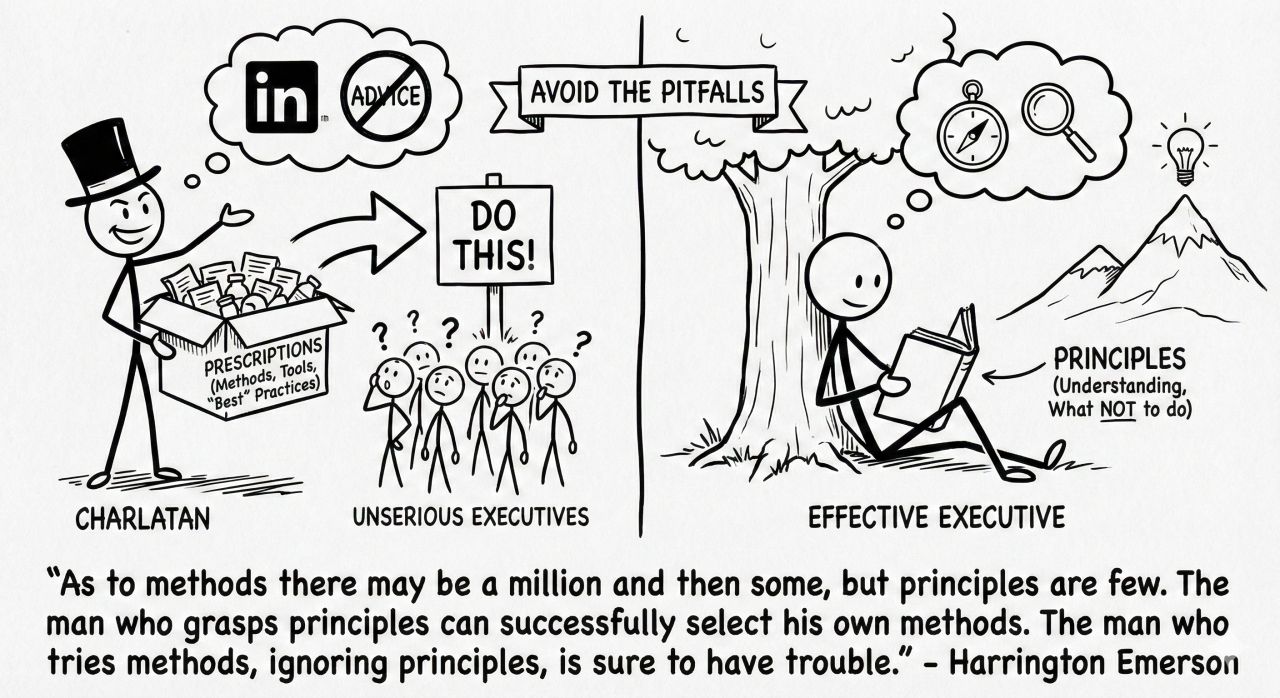
The pillar questions which define the QSet (and ensure semantic normalisation) are the essential ‘craft skill’ and expertise. It encapsulates and captures the role of experience as illustrated by a cartoon …
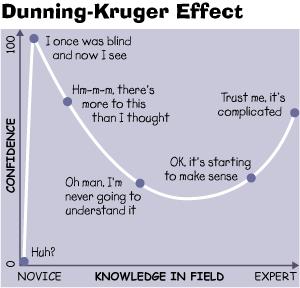
It reflects the move along the Dunning-Kruger curve as the expert learns what ‘not to do’ as their experience grows in contested areas …
Technical Support and Development
Whilst not a prime focus of a business plan a ‘deep dive’ into STPrism will require some technical support and development. There are many aspects of Data-Eng which work here on a small (sed/cut&paste/obsidian) scale but will not scale to larger data domains or rapidly changing data.
The whole Google/NotebookLM/Gemini infrastructure is highly agile and therefore unreliable and an external harness for version control is recommended (comprising repeatable data pipelines, version control and automated verification). Longer term escape routes from the Google ecosystem might be required if certain key capabilities (such as free, sharable NotebookLMs) are withdrawn - I still mourn their retirement of RSS.
£ Translation, Education and Training
The contribution of the AI component is to use Systems Thinking concepts (or concepts from another QSet) to make recommendations to ‘untie the knot’ and identify new avenues for progress. It is another thing to translate these ideas into practical plans for action.
In some cases this may require a translation of the concepts, education in the practical significance & implementation of the idea and training in many aspects of Systems Thinking.