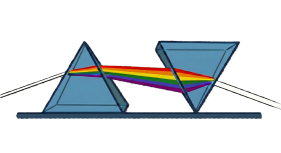
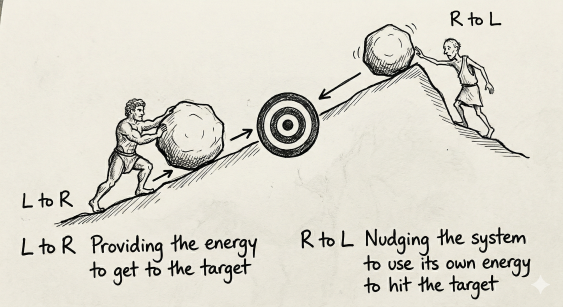
This analysis explores symmetry breaking as the primary mechanism for transitioning a system from Weaver’s “disorganized complexity” into the functional domain of “organized complexity.” We utilize the designation L to R to describe the excitation of static systems into dynamic states, and R to L to define the process of channelling random dynamics into (slightly) more constrained, useful states.
RtoL Quick Guide: Strategic Advice for “Nudging” (Transitioning States)
1. Weaver’s Insights: From Statistical Averages to Directed Work
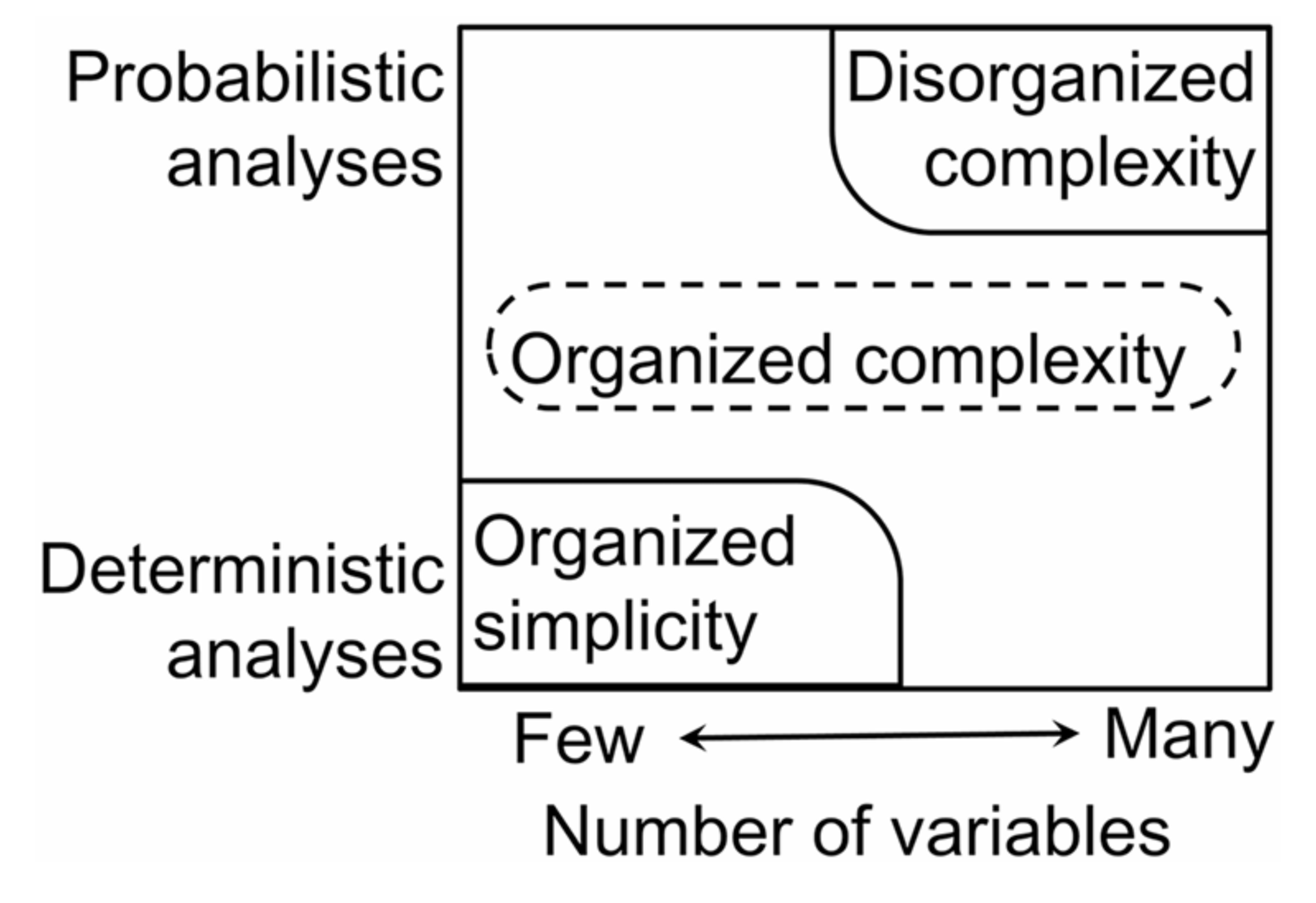
Warren Weaver’s concept of disorganized complexity relies on the principles of statistical mechanics. In such systems, the behaviour of individual components—much like a single gas molecule—remains unpredictable. However, the aggregate behaviour of the population is predictable and “simple” when viewed as an average.
Observing Brownian motion illustrates this randomness: a target particle moves erratically because gas molecules collide with it from all directions. In an aggregate “random walk,” these underlying agents exert equal force in all directions, maintaining symmetry. If a mechanism forced all molecules to move in a single direction, the system would break this symmetry and perform concerted, useful work.
The design challenge lies in “funneling” this random energy without violating the laws of physics (avoiding the fallacies of Maxwell’s Demon). By harnessing the energy already inherent in the system and breaking its symmetry, we can extract a significant, useful yield.
2. Breaking Symmetry: The Liverpool Street Thought Experiment
Consider the 250,000 daily commuters at Liverpool Street Station in London. If I wish to deliver a gold sovereign to my village of Meldreth (50 miles north), handing a coin to a random, trustworthy commuter represents a high-risk low yield ridiculous gamble. Because the “symmetry of journeys” at a major terminus spans all directions, most sovereigns would be scattered across all points of the compass. If however all the trains from Liverpool Street went to Meldreth the gamble would be much less and I might consider it to be a reliable to get the sovereign to my house for free.
To make the system useful for a specific objective, we must break the symmetry of this natural, chaotic state. We do not require a perfectly ordered system; rather, we need to introduce a systemic bias that channels disparate behaviours toward a preferred trajectory.
Harvesting Yield: Lowering the Stakes
We can utilize randomness effectively if we “bet on every agent.” If we replace the high-value sovereign with a low-cost leaflet for a Meldreth pub, the economics shift. If 250,000 leaflets cost £10 to produce, we only require the 50 resident Meldreth commuters to spend 20p each to achieve a positive return on investment.
In chaos-based approaches, yield—rather than a guarantee of individual success—dictates the cost-benefit ratio. Low-yield, low-stakes interventions often prove more cost-effective than high-precision, high-cost mandates. By even slightly channelling randomness, we can markedly increase the aggregate yield.
3. The Nature of the “Oblique” Nudge
Every dynamic system contains potential, whether in the form of physical energy, workforce resources, or population-wide ideas. The design challenge involves “stealing” the wasteful dissipation of that potential and funnelling it toward a useful yield.
For example, the energy spent on office gossip or sports talk in a professional setting represents “dissipated” potential. A successful nudge redirects this energy toward desired outcomes (e.g., Systems Thinking or customer-centricity). Crucially, these nudges are often oblique—they do not directly address the technical content of the work. One does not need to be an expert in Theoretical Physics to nudge physicists toward more frequent collaboration; one only needs to influence the social environment that facilitates their interaction.
Human systems are both more susceptible to chaos but also amenable to managed nudges.
4. A Physical Archetype: The Laser
The operation of a laser provides a perfect physical model for the R to L transition. In many physical systems, external energy “pumps” atoms into an excited state, but they discharge that energy through spontaneous emission, which is random in both time and direction.
The laser apparatus breaks this chaotic state using a neodymium substrate in which discharge (relaxation) is self-synchronised and mirrors which control the direction of the light beams. This process forces photons to align, breaking two fundamental symmetries:
-
Temporal Symmetry: Transitioning from random discharge to a synchronized “flash.”
-
Spatial Symmetry: Transitioning from omnidirectional radiation to a coherent “beam.”
This transforms disorganized complexity into a highly instrumental technology by harnessing existing physical properties rather than suppressing them.
5. Human Systems: Minimal Intervention in Practice
The R to L transition applies these principles to social and organizational structures through Minimal Intervention.
-
The Social Flash Mob: This serves as a coordination trigger. By designating a specific time and location, an organizer synchronizes thousands of independent actors. This does not force participation; it aligns existing interests into a coherent collective event.
-
Organizational Knowledge: James Wilks’ classic example involves the strategic placement of a coffee machine to improve cohesion among engineers. Rather than imposing a rigid “Knowledge Management” system (an uphill struggle), this social nudge utilizes the natural entropic process of conversation. By facilitating spontaneous meetings, the organization breaks the “asymmetry of randomness,” allowing professional knowledge to crystallize naturally into high-yield technical discussions.
6. Redefining the Systems Paradigm
This approach marks a departure from traditional orthodoxies:
-
Systems Thinking typically begins with a conceptual model (such as stocks, flows, boundaries). However, a model of a system is not the same as a functional intervention.
-
Complexity Science often focuses on how simple rules create complex patterns (e.g., fractals). While insightful, this often moves from simple to complex—the opposite of organizational needs.
The R to L transition focuses on the inverse: starting with existing chaos and identifying the minimal nudge required to guide the system toward a desired state. Rather than pushing a stone uphill through forced structure, we identify the path that allows the stone to “roll downhill” into a productive location. We harness natural dynamics to maximize yield with minimal energy expenditure.